
Jelly Bloom
A fun and family-friendly outdoor game featuring camera-tracked glowing balls and projection mapping on a historic building in Victoria, BC.
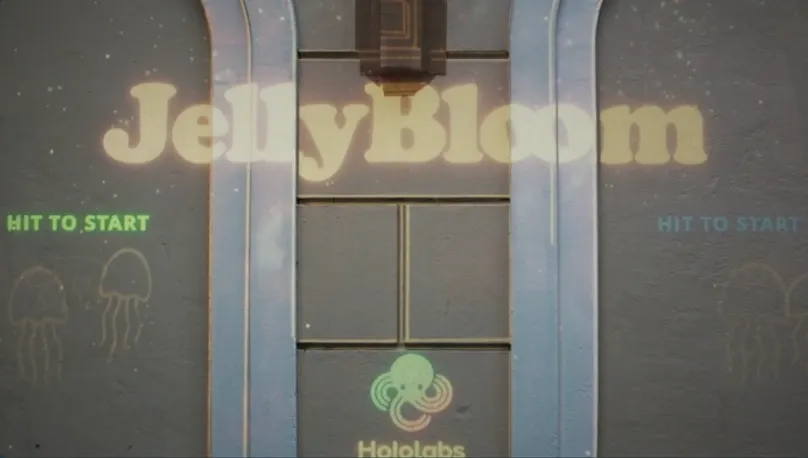
Jelly Bloom is a projected-mapped game designed, engineered and operated by Hololabs Studio, premiered at the Victoria at Dusk festival in February 2026. Two players throw balls of light at a wall of drifting jellyfish, and every hit blooms one back to life. Land enough of them and the whole ocean lights up.
It’s a simple, family-friendly game but underneath is a real-time computer vision and projection mapping system that turns a building façade into a responsive game board, with nothing between the player and the game but a glowing ball in their hand.
A wall becomes the play surface
Jelly Bloom was first staged in Bastion Square in Victoria, BC, on the century-old façade of the old Maritime Museum. Our creative team wanted to make the building part of the design rather than a surface to cover up, so we projection-mapped the piece around the arches of two filled-in windows, framing each one as a portal looking through into the sea. The architecture does the scenography and the projection adds an extra layer of depth.
Camera tracking for quick interaction
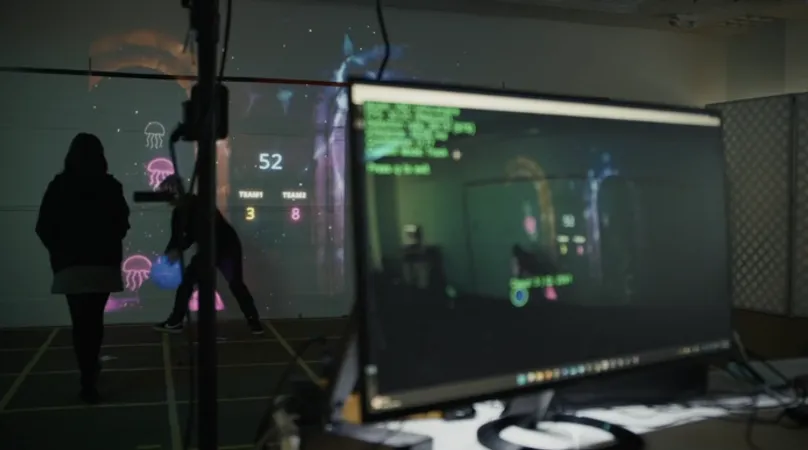
The game is played with glowing LED balls. A camera mounted at the back of the scene watches the projection surface and tracks the balls in real time, resolving where each one strikes the wall and turning that impact into a hit in the game.
That is the whole interface. There is no controller to hand out, no app to download, no sensor to strap on, and nothing for an operator to reset between rounds. Players walk up, throw, and the wall reacts, which is what makes the piece work in a crowd, where the queue has to keep moving and the rules have to be legible while players wait.
Thoughtful art direction for computer vision
An interesting challenge for this project was the art direction. The tracking camera looks for small bright objects against the projected scene. A bold, solid, brightly lit jellyfish looks a great deal like an LED ball, and the tracker will happily chase it. So the jellyfish were deliberately drawn translucent: luminous enough to read as bioluminescent sea life to a player, transparent enough that the object tracking never mistakes the artwork for the ball.
The experience was built and tested at the Immersive Lab just two blocks away, where the team was able to set up a test environment to iterate on art choices that would minimize interference with tracking. Art direction and computer vision were tuned against each other rather than in sequence.
One minute, two players, one blooming ocean
A round of Jelly Bloom is just a minute long and pits two players head to head, each trying to bloom as many jellies as they can before time runs out.
Every hit carries an area of effect, so a well-placed throw blooms a cluster rather than a single target. Keen players realize that they can throw their ball at their opponent’s screen and convert jellies over to their color. This adds just enough strategic depth to make the competitive round feel real without ever needing to be explained. The round resolves into a beautiful moment where the sea comes fully into bloom, and the piece resets for the next pair.
Sound is part of the feedback loop and adds to the immersion. Rather than using off-the-shelf audio, we built a lightweight custom audio system that responds to play in real time. Each bloom registers with a sound effect and the mix thickens as the ocean fills in, resolving in a lush finale.
How Jelly Bloom works
The video below presents a walkthrough of the camera tracking setup, showing how two LED balls are tracked in real time, and the basics of the computer vision, game design, and art direction.
Project at a glance:
- Commissioned by the Victoria at Dusk festival, as a fun family-friendly nighttime experience, running for three winter evenings.
- Projection mapping authored to the arches of a heritage building façade.
- Real-time camera tracking and object tracking of LED balls, with hit detection resolved directly on the projection surface.
- Competitive multiplayer game design: timed head-to-head rounds, area-of-effect scoring, full-screen finale.
- Reactive projected environment driven live by player input.
- Custom real-time audio system, reactive to gameplay.
- A complete location-based entertainment (LBE) interactive exhibit: designed, built, transported, installed and operated by one team.